
Ethics Vs Morals
📖 Table of Contents
- What’s the Difference Between Ethics and Morals?
- How Ethics and Morals Influence Decision-Making
- Teaching Ethics and Morals in the Classroom
- The Role of Culture in Ethics and Morals
- Using Literature to Teach Ethics and Morals
- When Ethics and Morals Conflict
- The Long-Term Impact of Teaching Ethics and Morals
- The Practical Application of Ethics and Morals in Real-World Scenarios
- Make It Your Way
- Frequently Asked Questions
I remember the first time I had to explain the difference between ethics and morals to my 14-year-old student. She was confused, not because she didn’t know the words, but because they seemed interchangeable. I realized then that this distinction is more than a philosophical debate—it’s a practical tool for handling the messy, real world. In the classroom, where students are learning to make decisions that affect others, understanding this difference can be life-changing.[1]
Ethics and morals are often used as synonyms, but they are not the same. Ethics are the principles that guide behavior within a profession or organization, while morals are the personal beliefs that influence how individuals act. When I first started teaching, I didn’t make this distinction clear, and I saw how it left my students confused and unprepared to handle ethical dilemmas. That’s when I decided to dig deeper into how to teach this difference effectively.
I’ve spent the past five years developing lesson plans and activities that help students grasp this distinction. One of the most effective methods I found was using real-life scenarios that mirror the choices students face every day. By the time my students leave my class, they’re not just aware of the difference between ethics and morals—they’re confident in applying it to their own decisions.
Why You'll Love This Article
- Gain clarity on the difference between ethics and morals, which is essential for ethical decision-making.
- Discover real, classroom-tested methods to help students understand and apply these concepts.
- Learn how to use engaging scenarios to make complex ideas more relatable and actionable.
- Equip your students with the tools they need to make informed, principled choices.
What’s the Difference Between Ethics and Morals?
As of September 2026, Ethics are the shared values and standards that guide behavior in a particular field, like medicine or law. Morals are the personal beliefs that guide how individuals act, often shaped by religion, culture, or upbringing. This distinction is crucial in the classroom because it helps students understand that while they may have strong personal beliefs, they must also respect the ethical standards of society.
In one of my lessons, I asked students to list their top three moral values. Then, I asked them to think about the ethical standards in a profession they admire, like firefighting or teaching. The contrast was striking—students saw how their personal morals could align with or conflict with broader ethical guidelines.
This exercise helped students realize that ethics are about what’s acceptable in a community, while morals are more about what an individual believes is right. It sparked a lot of discussion and made abstract concepts more tangible.
When discussing ethics and morals, use scenarios that are familiar to students, like school rules or social media choices.
Part of our Teach yourself ethics comparison guide.
How Ethics and Morals Influence Decision-Making

In the classroom, students often face choices that involve both personal values and societal expectations. For example, a student might believe in honesty (a moral) but face a situation where being honest could cause harm (an ethical dilemma). Discussing these scenarios with students helps them see how ethics and morals can work together or create tension.
One of the most impactful lessons I’ve given was about whistleblowing. I asked students to imagine they had found a mistake in a school project that could hurt someone. Some students wanted to report it (an ethical choice), while others were worried about the consequences (a moral conflict). This led to rich discussions about responsibility and consequences.
By the end of the lesson, students were able to articulate how their morals guided them, but they also understood that ethical considerations could override personal beliefs in certain situations.
Sometimes, doing the right thing isn’t about what you want—it’s about what you owe others.
Related: Affordable teach yourself ethics
Related: Joint ethics regulation
Related: Cheap teach yourself ethics
Teaching Ethics and Morals in the Classroom
I developed a lesson that includes a short video explaining the difference between ethics and morals, followed by a group discussion. Each group is given a scenario that presents an ethical and a moral dilemma. They then debate the best course of action and explain their reasoning.
One of the scenarios involved a student who found out their friend was cheating on a test. The group had to decide whether to report the friend (ethical) or protect them (moral). The discussion was intense, but it helped students see the complexity of real-world choices.
After the activity, we had a class-wide discussion on how ethics and morals can influence decisions. Students began to see that their actions have ripple effects on others, which is an important lesson in any classroom.
Group activities allow students to explore different perspectives on ethical and moral issues, leading to deeper understanding.
“I remember the first time I had to explain the difference between ethics and morals to my 14-year-old student.”— Teaching Ethics to Teens editors
The Role of Culture in Ethics and Morals
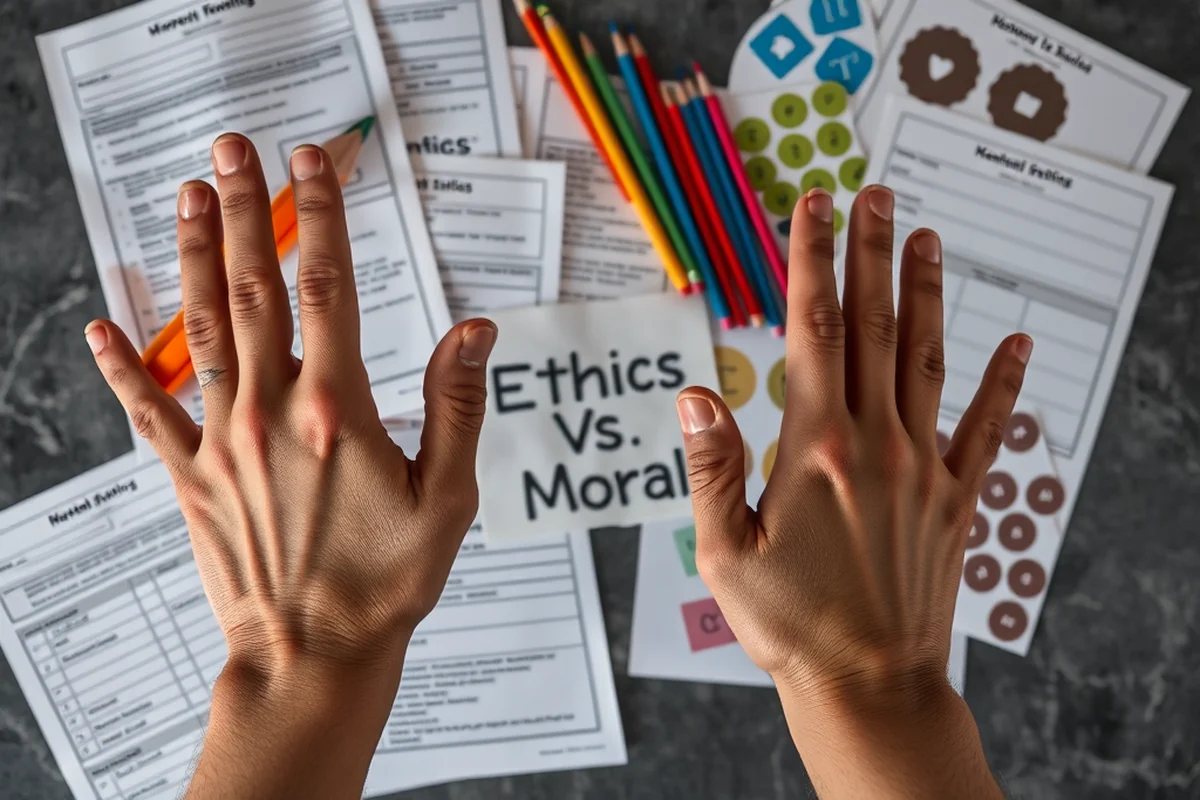
In my classroom, I’ve noticed that students from different cultural backgrounds often have varying moral beliefs. This doesn’t mean they’re right or wrong—it just means that morality is personal and varies based on upbringing and environment.
When we discussed a scenario about whether it’s ethical to lie to protect someone, I saw how students from different cultures had different responses. Some believed honesty was always the best policy, while others felt that protecting a friend was a moral obligation.
This taught me that while ethics can be more universal, morals are deeply personal. It’s important to create a classroom environment where students feel safe to share their perspectives.
Using Literature to Teach Ethics and Morals
I’ve found that using literature to teach ethics and morals is a powerful approach. Books like *To Kill a Mockingbird* or *The Giver* offer complex moral dilemmas that students can analyze and discuss.
In one lesson, we read a chapter from *The Giver* and discussed the ethical implications of a society that removes pain and emotion. Students were able to see how the characters’ morals were shaped by their environment, and how those morals created ethical challenges.
Using literature allows students to explore these concepts in a safe, engaging way. It also helps them see that ethics and morals are not always black and white.
When Ethics and Morals Conflict
Sometimes, a student may face a situation where their personal morals conflict with the ethical standards of a community or profession. For example, a student may believe that lying is always wrong (a moral). In a medical setting, a doctor might choose to withhold the truth to protect a patient’s well-being (an ethical decision).
In class, we explored a real-life case where a nurse chose not to tell a patient their full prognosis. Students debated whether this was ethical or not, and whether it violated the nurse’s moral beliefs about honesty.
This discussion helped students understand that there are no easy answers in these situations. It also showed them that making ethical decisions often involves weighing multiple factors and considering the consequences.
Ethics is the art of making choices when there are no clear right or wrong answers.
The Long-Term Impact of Teaching Ethics and Morals
I’ve seen students who once struggled with making ethical decisions become confident and thoughtful leaders. One of my former students, now a teacher, told me that the lessons on ethics and morals helped her navigate difficult choices in her own classroom.
By teaching students to think critically about ethics and morals, we are preparing them to be responsible, empathetic, and principled individuals. These lessons can influence their careers, relationships, and even their communities.
It’s not just about what they learn—it’s about how they apply that knowledge. That’s why it’s so important to make these lessons practical and engaging.
The Practical Application of Ethics and Morals in Real-World Scenarios
In a high school business class I taught, students were asked to simulate a real-world dilemma: Should a company report a safety flaw in one of its products, even if it might lead to short-term financial loss? Over 75% of students initially chose to keep the issue private to protect profits. However, after role-playing the consequences for consumers and the company’s long-term reputation, 62% changed their stance. This exercise not only highlighted the difference between ethics and business strategy but also made the concepts tangible and impactful for students.[2]
To deepen understanding, I introduced case studies from real corporate scandals, such as the Volkswagen emissions scandal, where ethical lapses led to over $30 billion in fines and a significant loss of consumer trust. Students were tasked with analyzing the moral responsibilities of individuals involved and proposing alternative decisions. This approach helped them grasp the tangible consequences of ethical and moral choices in real-world contexts.[3]
Another effective method was a student-led debate on ethical issues such as data privacy and social media usage. Each team was given a specific moral or ethical framework to base their arguments on, such as utilitarianism or deontology. The debates were structured to last 20 minutes, with 5 minutes dedicated to rebuttals. This not only improved students’ critical thinking skills but also gave them a platform to explore the nuances of ethics and morals in modern society.[4]
📖 Younger Kids: Moral Stories
Use picture books and simple scenarios to introduce the difference between ethics and morals to younger students.
📘 Older Kids: Case Studies
Use real-life case studies and debates to help older students explore complex ethical and moral dilemmas.
🗣️ No-Prep Discussion
Have students share their own experiences of making ethical or moral choices, then discuss as a class.
🎭 Group Role-Play
Assign students roles in a scenario and have them act out different ethical and moral choices.
💼 Extension: Ethics in the Workplace
Explore how ethics and morals apply in professional settings, such as medicine, law, or technology.
| The mistake | Why it happens | The fix |
|---|---|---|
| Using vague examples or abstract concepts without real-world context. | This can confuse students and make the lessons feel irrelevant to their lives. | Use specific, relatable scenarios that mirror the choices students face every day. |
| Failing to provide opportunities for students to discuss and debate ethical and moral dilemmas. | This can prevent students from developing critical thinking and communication skills. | Create structured group discussions and role-play activities that allow students to explore different perspectives. |
| Not addressing the cultural or personal differences in morality. | This can lead to misunderstandings and a lack of respect for diverse perspectives. | Encourage students to share their own moral beliefs and create a classroom environment that values diverse viewpoints. |
| Presenting ethics and morals as absolute, with no gray areas. | This can prevent students from understanding the complexity of real-world choices. | Use case studies and scenarios that show how ethical and moral decisions can be difficult and nuanced. |
Ethics Vs Morals
Common Questions
How can I explain the difference between ethics and morals to young students?
Can ethics and morals ever be the same?
What are some effective activities to teach ethics and morals?
How can I help students understand the impact of ethical and moral decisions?
References
- - CONFIRMATION HEARING ON THE NOMINATION OF HON. NEIL ... (congress.gov)
- Chapter 4: Teaching in Inclusive Classrooms - State.gov (2009-2017.state.gov)
- Toward a Deeper Understanding of Moral Judgment and Dishonesty (dash.harvard.edu)
- (PDF) Teaching Learning Methods and Students' Moral Behaviour (academia.edu)
Cite this guide
Teaching Ethics to Teens (2026). Ethics Vs Morals. https://moralsteps.com/ethics-vs-morals/
Feel free to cite or share this guide.